Purchasing property in the capital of Silicon Valley is a major financial milestone. San Jose's median home sale price was about $1.47 million as of May 2026, making financing an especially important part of the buying strategy.
When comparing an FHA vs conventional loan in San Jose, buyers should look beyond the minimum down payment. Credit requirements, mortgage insurance, loan limits, property eligibility, and the strength of an offer can all affect which mortgage makes more sense.
Understanding these differences before you begin making offers can help you choose financing that fits both your budget and your home-buying goals.
Comparing an FHA vs Conventional Loan in San Jose
When comparing an FHA vs conventional loan in San Jose, FHA loans offer more flexible qualification and require as little as 3.5% down for eligible borrowers. Conventional loans may allow 3% down and offer cancellable PMI, potentially providing lower long-term costs for buyers with stronger credit.

Exploring San Jose Mortgage Options for Homebuyers
The Silicon Valley Market Reality
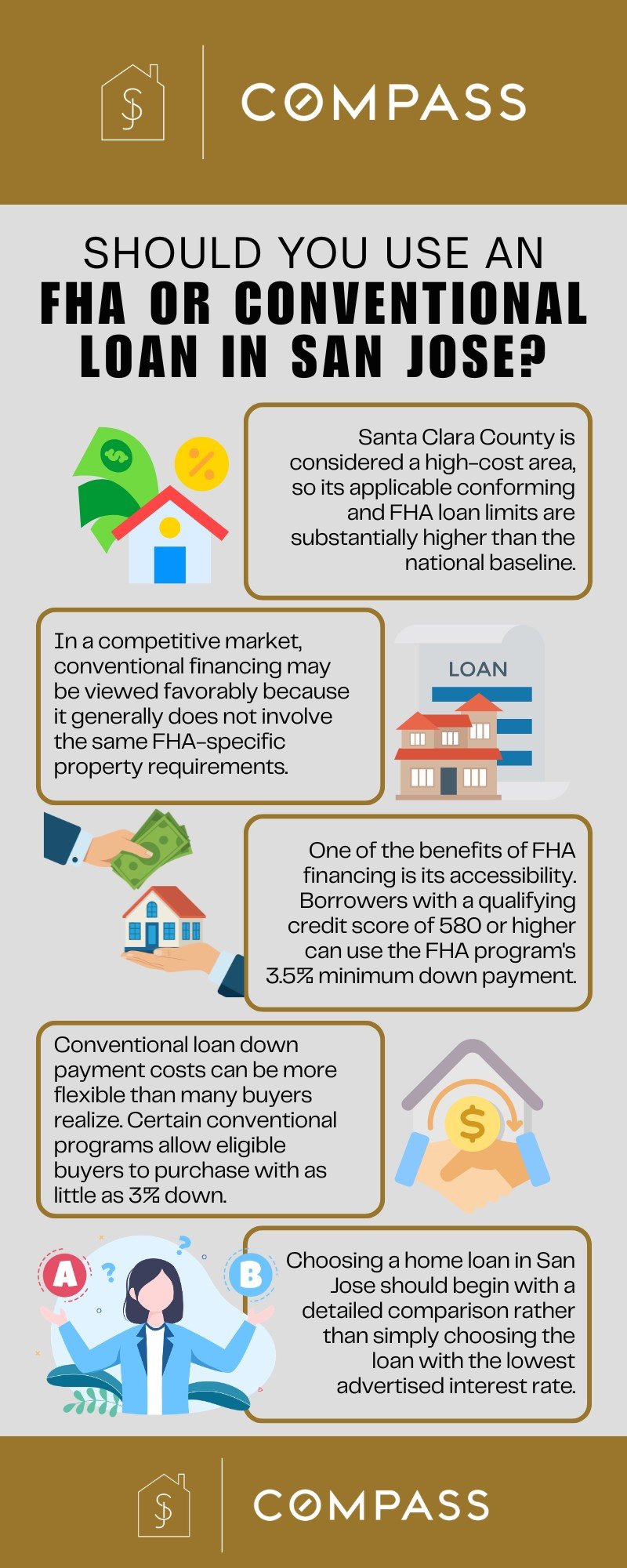
Navigating San Jose mortgage options for homebuyers requires paying close attention to loan limits. Santa Clara County is considered a high-cost area, so its applicable conforming and FHA loan limits are substantially higher than the national baseline.
For 2026, the FHA loan limit for a one-unit property in Santa Clara County is $1,249,125. That higher limit can make FHA financing viable for more local buyers than it would be in a lower-cost market.
However, San Jose's home prices can still exceed that amount, meaning some buyers may need a larger down payment, a different loan structure, or jumbo financing. Buyers should have their lender calculate the maximum loan amount they qualify for before deciding how much home they can comfortably afford.
The local market also moves quickly. Recent San Jose data shows homes receiving multiple offers on average and spending roughly two weeks on the market, although conditions vary by neighborhood and property type.
Seller Preferences
Financing can influence how a seller evaluates competing offers. In a competitive market, conventional financing may sometimes be viewed favorably because it generally does not involve the same FHA-specific property requirements.
FHA appraisals include minimum property requirements intended to address safety, security, and soundness. If an appraiser identifies an issue that does not meet FHA requirements, repairs or additional documentation may be necessary before the loan can close.
That does not mean an FHA buyer cannot win a bidding war. Price, earnest money, contingencies, closing timeline, down payment, and the buyer's overall financial profile can all influence a seller's decision. The condition of the property also matters.
For a well-maintained home that already meets FHA requirements, the financing difference may be less significant.

Navigating FHA Loan Requirements in California
Flexible Credit and Income Ratios
One of the primary benefits of FHA financing is its accessibility. Borrowers with a qualifying credit score of 580 or higher can generally use the FHA program's 3.5% minimum down payment.
Borrowers with credit scores from 500 to 579 generally need at least 10% down. Lenders can impose additional requirements, so meeting the FHA minimum does not guarantee approval.
FHA underwriting may also accommodate some borrowers whose debt-to-income ratios or credit histories make conventional financing more difficult. The lender still reviews income, employment, debts, assets, credit history, and other financial information.
For San Jose buyers, the lower minimum down payment can be particularly useful because a 3.5% down payment on a high-priced property requires substantially less cash upfront than a 20% down payment.
However, buyers should not choose FHA solely because it requires less cash. The complete cost of the mortgage matters.
The Cost of Mortgage Insurance
Mortgage insurance is one of the biggest differences between FHA and conventional financing.
FHA loans generally require both an upfront Mortgage Insurance Premium and an annual mortgage insurance premium paid through the borrower's monthly payments. The upfront premium can generally be financed into the mortgage.
For FHA loans with an original loan-to-value ratio above 90%, annual mortgage insurance generally lasts for the mortgage term. With a 90% or lower original loan-to-value ratio, the annual mortgage insurance generally lasts 11 years.
This makes the size of the down payment an important part of the FHA cost calculation.

Evaluating Conventional Loan Down Payment Costs
Upfront Flexibility and PMI
Conventional loan down payment costs can be more flexible than many buyers realize. Certain conventional programs allow eligible buyers to purchase with as little as 3% down.
A 20% down payment is not a universal requirement for conventional financing.
When a conventional borrower puts less than 20% down, PMI is typically required. The amount can vary based on factors such as credit score, loan-to-value ratio, loan amount, and other characteristics.
One important advantage is that conventional PMI is generally cancellable once the borrower reaches the applicable equity threshold.
Under many circumstances, borrowers can request cancellation when they reach 20% equity, while automatic termination can occur later under federal rules if other requirements are satisfied.
Long-Term Savings
Conventional financing can be particularly attractive for buyers with strong credit and stable finances. A 620 credit score is a common minimum for conventional financing, although individual lenders and loan programs can have different requirements.
Higher credit scores can improve a borrower's pricing and PMI costs, but there is no universal score that guarantees the best mortgage rate. Lenders consider multiple factors, including credit, down payment, loan amount, property type, occupancy, and current market conditions.
For a buyer who expects to stay in the property for many years, the ability to eventually eliminate PMI can make conventional financing less expensive over time than an FHA loan with long-term mortgage insurance.

Choosing a Home Loan in San Jose
Strategic Prequalification
Choosing a home loan in San Jose should begin with a detailed comparison rather than simply choosing the loan with the lowest advertised interest rate.
Ask a local mortgage professional to compare FHA and conventional financing using the same purchase price.
Review the down payment, interest rate, monthly principal and interest, mortgage insurance, property taxes, homeowners insurance, closing costs, and the amount of cash you would have remaining after closing.
A side-by-side comparison can reveal important differences. One loan may require less money upfront, while another may provide lower monthly costs or a better path to eliminating mortgage insurance.
Getting prequalified or preapproved before shopping also helps you understand your realistic price range. In San Jose's competitive market, having financing lined up can make it easier to act quickly when the right property becomes available.
Condo Approvals
Buyers considering San Jose condominiums and townhomes should discuss property eligibility with their lender before making an offer.
FHA financing is available for eligible condominium properties, but a condominium project does not necessarily have to receive full FHA project approval in every situation.
FHA also has a Single-Unit Approval process that can allow an individual unit in a project that is not FHA-approved to qualify if the applicable requirements are met.
Because FHA eligibility depends on both the property and the borrower, buyers should have their lender review the condominium project early in the transaction. Conventional financing may offer another option if a particular project does not satisfy FHA requirements.
Mortgage Loan Comparison Table
Loan Feature | FHA Loan | Conventional Loan |
|---|---|---|
Minimum Credit Score | 580 for 3.5% down; 500–579 generally requires 10% down | 620 is a common minimum; lender requirements vary |
Minimum Down Payment | 3.5% | 3% for eligible borrowers |
Mortgage Insurance | Upfront and annual/monthly MIP; duration depends partly on down payment | Monthly PMI when required; generally cancellable as equity increases |
Seller Preference in SJ | May receive more scrutiny when property-condition issues affect FHA eligibility | Often attractive to sellers because there are fewer FHA-specific property requirements |
Property Condition Rules | FHA minimum property requirements for safety, soundness, and livability | Conventional appraisal and property eligibility requirements apply |
Align Your Loan With Your Buying Strategy
Successfully purchasing a home in Santa Clara County requires a financing strategy that matches your financial situation and the property you want to buy.
Review the FHA loan requirements in California, compare conventional loan down payment costs, and evaluate the broader San Jose mortgage options for homebuyers before deciding which loan program to use.
FHA financing may make sense for buyers who need a smaller down payment or more flexible qualification standards. Conventional financing may be more attractive to buyers with stronger credit and enough savings to take advantage of potentially lower mortgage insurance costs over time.
Whether you are comparing an FHA vs conventional loan in San Jose for a condo, townhome, or single-family home, getting the numbers from a qualified local mortgage professional before making an offer can help you choose financing with confidence.
If you're planning to buy in San Jose and want to compare your financing options before making an offer, I can help you evaluate the numbers and connect your financing strategy with your home search.
Call me today at (408) 781-5775 or email [email protected] to get started.