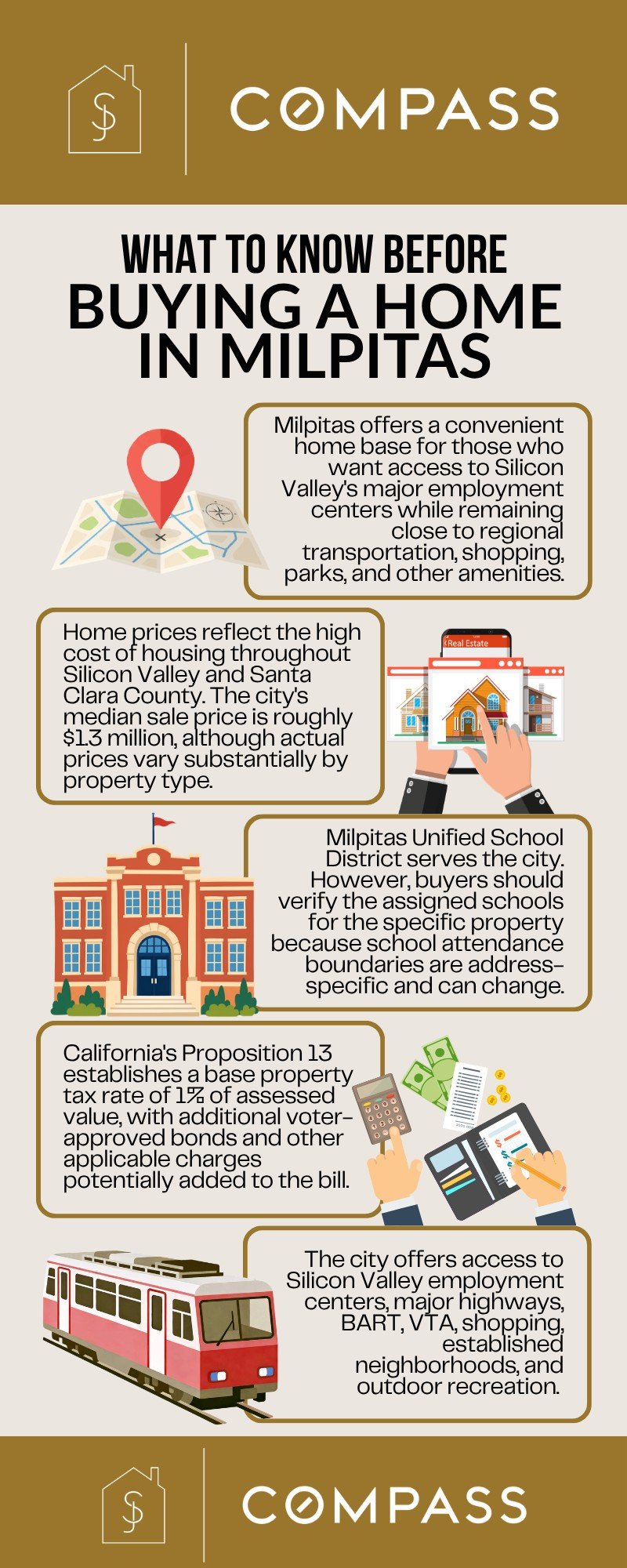
Located between San Jose and Fremont, Milpitas offers a convenient home base for people who want access to Silicon Valley's major employment centers while remaining close to regional transportation, shopping, parks, and other amenities.
The city combines established residential neighborhoods with newer townhomes and transit-oriented development. The Milpitas Transit Center connects BART with VTA services near the Great Mall, giving commuters another option besides driving.
The city's location near major roadways, employment centers, and regional transportation has helped make it an attractive place for Bay Area homebuyers. However, buying a property here requires careful planning.
Housing costs are substantial, market conditions vary by property type, and neighborhood characteristics can change considerably from one part of the city to another. Here's what to know before buying a home in Milpitas.
Essential Tips for Buying a Home in Milpitas
When buying a home in Milpitas, get pre-approved, set a realistic budget, and research comparable sales, schools, commute times, and HOA costs. Account for taxes, insurance, maintenance, and utilities, and establish your maximum purchase price before making offers so you can act confidently when the right home appears.

Navigating the Milpitas Housing Market
Silicon Valley Demand
Milpitas benefits from its location in the South Bay and its proximity to major Silicon Valley employment centers. Interstate 880, Interstate 680, and State Route 237 provide road connections, while BART and VTA provide alternatives for some commuters.
The Milpitas Transit Center is located near the Great Mall and includes the Milpitas BART station and VTA services. BART provides regional connections toward the East Bay and San Francisco, while VTA connects Milpitas with other parts of Santa Clara County.
This accessibility can be particularly valuable for buyers working in San Jose, Santa Clara, North San Jose, and other South Bay employment centers. For many households, reducing dependence on a long daily drive is an important part of the home-buying decision.
Inventory and Competition
The Milpitas housing market remains competitive, although conditions vary depending on the property type, price range, and location.
Redfin reported a median sale price of approximately $1.29 million for Milpitas during the three months ending May 2026. Homes sold in a median of about 15 days, while the median sale price was down approximately 9.5% from the same period a year earlier.
Those numbers illustrate why buyers should avoid assuming that every Milpitas property will attract multiple offers or sell above asking price. Some homes can move quickly, while others may take longer to sell, depending on condition, pricing, and demand.
If you are ready to buy a Milpitas house, having financing in place and knowing your preferred offer terms can help you respond quickly without skipping appropriate inspections or due diligence.

Evaluating Milpitas Home Prices
Budgeting for the Bay Area
Milpitas home prices reflect the high cost of housing throughout Silicon Valley and Santa Clara County. Current market data put the city's median sale price at roughly $1.3 million, although actual prices vary substantially by property type.
A condominium or townhome can have a very different price point from a detached single-family home. Location, lot size, square footage, construction date, condition, upgrades, and proximity to transit can all affect the price of an individual property.
For that reason, buyers should not use a citywide median as a substitute for researching comparable properties. A local agent can help identify recent sales that more closely match the home you are considering.
If you plan to buy a house in Milpitas, CA, also account for California's property taxes and any applicable special assessments. Your lender's monthly payment estimate may not tell the entire story of your long-term housing expenses.
Property Value Trends
Buying a home in Milpitas can offer long-term lifestyle and location advantages, but buyers should not assume that property values will increase every year.
Recent market data demonstrate why. Milpitas' median sale price was lower year over year in the latest Redfin data, showing that even a desirable Silicon Valley market can experience periods of price adjustment.
The city's established transportation network, access to employment centers, and continued development can contribute to its long-term appeal. However, future property values will also depend on interest rates, employment trends, housing supply, economic conditions, and the specific characteristics of each property.
A good purchase should therefore make sense for your finances and expected length of ownership, rather than relying solely on the expectation of future appreciation.

Exploring Milpitas, CA, Real Estate and Neighborhoods
Diverse Housing Options
The Milpitas, CA, real estate market includes established single-family homes, condominiums, townhomes, and newer residential developments.
The area around the Milpitas Transit Center and Great Mall has experienced significant development, including newer attached housing near regional transportation. These properties can appeal to buyers who value contemporary layouts and convenient access to transit.
Established residential areas offer a different experience. Buyers may find traditional single-family homes, mature landscaping, and larger lots, depending on the location.
When comparing new construction with resale properties, look beyond the list price.
Consider HOA dues, property taxes, builder upgrades, warranties, parking, lot size, community amenities, and the potential maintenance requirements of each property.
The Appeal of the Foothills
The eastern side of Milpitas provides access to the foothills and a more open setting than some of the city's denser residential areas.
Properties in this part of the city can offer larger lots, views, and proximity to outdoor recreation. Ed R. Levin County Park alone covers 1,558 acres and includes trails, picnic areas, fishing, play areas, and other recreational facilities.
Homes near the foothills should still be evaluated individually. Buyers should pay attention to grading, drainage, landscaping, access, hillside conditions, and maintenance requirements during inspections and property review.
Finding the Best Milpitas Homes for Sale
Targeting Your Lifestyle Priorities
Before browsing Milpitas homes for sale, determine which features are genuinely important to your household.
Families should verify the school assignment for every property they consider. Milpitas Unified School District provides an official boundary map and school-finder tool, making it possible to check the assigned schools for a specific address.
School boundaries can change, so buyers should confirm current information directly with the district before making a decision.
Commuters should evaluate transportation based on their actual routine. Buyers who want public transportation may prefer properties closer to the Milpitas Transit Center, while those who drive regularly may prioritize convenient access to I-880, I-680, or SR-237.
Other factors to compare include parking, outdoor space, bedroom and bathroom layouts, lot size, renovation requirements, HOA restrictions, community amenities, and proximity to shopping and recreation.

Working With Local Experts
A locally experienced real estate agent can make the search more efficient by helping buyers compare properties, analyze recent sales, structure offers, and navigate the transaction.
This is especially helpful when comparing homes built in different periods or located in different parts of Milpitas. An older single-family home and a newer townhome may have very different maintenance requirements, HOA obligations, property-tax considerations, and resale characteristics.
An experienced agent can also help coordinate the many steps involved in a California real estate transaction, including inspections, disclosures, financing, title, escrow, and closing.
Milpitas Neighborhood Comparison Table
The areas below are broad buyer-oriented categories rather than official city neighborhood designations. Housing characteristics can vary within each area.
Neighborhood Area | Primary Vibe | Typical Housing Style | Commuter Access |
|---|---|---|---|
Transit Area (Great Mall) | Urban / Transit-Oriented | Modern Townhomes and Condos | Excellent; near BART and VTA |
Eastern Foothills | Scenic / Quiet | Single-Family Homes | Moderate; primarily car dependent |
Midtown Milpitas | Established / Accessible | Single-Family Homes, Townhomes, and Condos | Good; convenient to major roads |
Sunnyhills | Family-Centric / Traditional | Established Single-Family Subdivisions | Good; primarily car-dependent |
The Transit Area can be a strong fit for buyers who prioritize public transportation and newer housing. The Eastern Foothills may appeal to buyers who prefer more space, views, and proximity to outdoor recreation.
Midtown offers established housing and convenient road access, while Sunnyhills provides an established residential setting. Because these are broad categories, buyers should evaluate individual streets and properties rather than assuming every home within an area has the same characteristics.
Invest in Silicon Valley Convenience
Buying a home in Milpitas means balancing location, price, property characteristics, and everyday convenience.
The city offers access to Silicon Valley employment centers, major highways, BART, VTA, shopping, established neighborhoods, and outdoor recreation. At the same time, Milpitas home prices remain substantial, making careful budgeting and property comparison essential.
Current market data also show why buyers should approach the purchase with realistic expectations. Although homes can sell quickly, prices have experienced year-over-year declines, and market conditions vary by property type and location.
Whether you want to buy a house in Milpitas, CA, near established neighborhoods, find a modern townhome close to transit, or explore properties near the eastern foothills, a thoughtful search can help you find a home that works for both your lifestyle and finances.
A comprehensive Milpitas home buying guide should help you understand more than asking prices. It should give you a framework for evaluating neighborhoods, transportation, schools, ownership costs, property condition, and long-term suitability.
If you're considering buying a home in Milpitas and want help evaluating your options, I can help you understand the current market, compare neighborhoods, and identify properties that fit your goals.
Feel free to give me a call today at (408) 781-5775 or email [email protected] to discuss your home-buying plans.