Purchasing your first home in Silicon Valley is a major milestone.
In one of the nation’s most competitive housing markets, buying property in San Jose requires careful financial planning that extends well beyond saving for a down payment.
Many first-time buyers focus heavily on mortgage qualification and monthly payments, only to discover that additional upfront expenses can significantly impact their final budget.
Closing costs are one of the most important financial factors to understand before submitting an offer.
These expenses include lender fees, title and escrow charges, government recording fees, prepaid taxes, homeowners' insurance, and other transaction-related costs required to finalize the purchase of a home.
In a high-value real estate market like San Jose, these costs can add up quickly and often catch unprepared buyers off guard.
Understanding local practices is especially important because Northern California follows different real estate customs than Southern California and many other parts of the country.
Buyers who understand how these expenses are structured are far better equipped to budget confidently, negotiate strategically, and avoid last-minute surprises. This guide breaks down everything first-time buyers need to know about San Jose closing costs.
What Are Typical San Jose Closing Costs?
Typical San Jose closing costs range from 2% to 5% of the home’s purchase price. These expenses include lender origination fees, title insurance, escrow charges, prepaid taxes, and homeowners' insurance. For first-time buyers, understanding closing fees in San Jose, CA, is essential for accurately estimating the total cash needed to close successfully.
Navigating Santa Clara County Closing Cost Customs
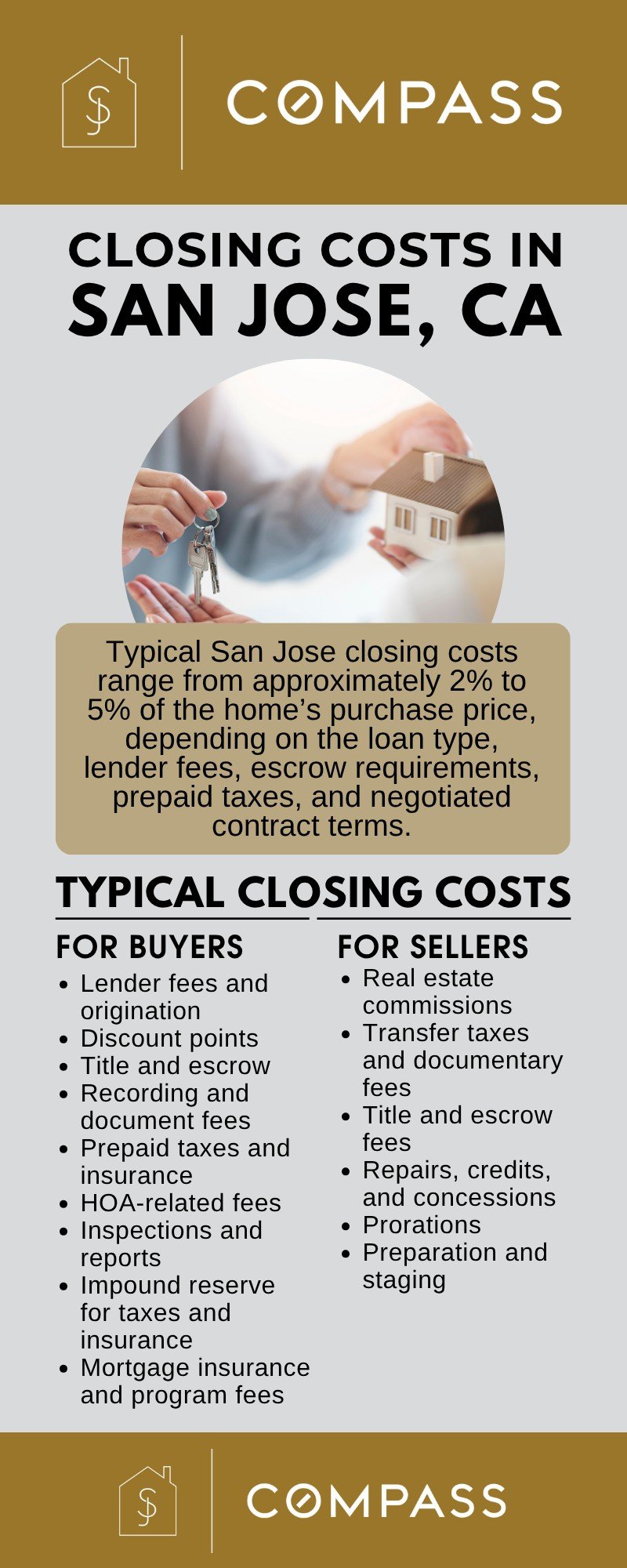
Typical San Jose closing costs range from approximately 2% to 5% of the home’s purchase price, depending on the loan type, lender fees, escrow requirements, prepaid taxes, and negotiated contract terms.
For first-time buyers, accurately estimating these expenses is essential, as they include lender origination fees, title insurance, escrow charges, and local taxes that directly affect the total cash needed at closing.

For perspective, if you purchase a $1.3 million starter home in San Jose, your closing costs could range from $26,000 to $65,000 in addition to your down payment.
The final amount depends on several variables, including whether you choose discount points to lower your mortgage interest rate, how much your lender requires for reserves, and the timing of your closing relative to property tax collection schedules.
When budgeting for closing fees in San Jose, CA, buyers should always ask their lender for a detailed Loan Estimate early in the mortgage process.
Who Pays What
Real estate transactions in Santa Clara County often follow established regional customs that differ from practices elsewhere in California.
In most Northern California transactions:
-
Buyers typically pay lender-related fees
-
Buyers often purchase the lender’s title insurance policy
-
Sellers commonly pay for the owner’s title insurance policy
-
Escrow fees are often split equally between buyer and seller
-
Recording fees are generally paid by the buyer
-
Transfer taxes may be negotiated depending on the transaction
Understanding Santa Clara County closing cost customs is critical because assumptions based on national averages may not reflect local practice.
That said, every purchase agreement is negotiable. In competitive seller’s markets, buyers may agree to absorb additional costs to strengthen their offer.
Title and Escrow Services
Title and escrow companies play a central role in every San Jose real estate transaction.
The title company performs a detailed review of public records to confirm the property has no ownership disputes, unpaid liens, or legal encumbrances. The escrow company acts as a neutral third party, securely holding funds and coordinating all closing documentation.
Choosing a reputable local provider matters because experienced San Jose escrow professionals understand regional requirements, timelines, and documentation standards that help ensure a smooth closing.
Understanding the San Jose Measure E Transfer Tax
The City Tax Impact
One of the most unique factors affecting high-value home purchases is the San Jose Measure E transfer tax.
San Jose voters approved Measure E to impose additional transfer tax rates on certain high-value real estate transactions. This tax applies to property sales exceeding specific price thresholds and can add substantial costs to qualifying transactions.

The tax structure generally affects luxury-tier transactions, with higher rates assessed as sale prices increase. Because San Jose home values remain elevated, more buyers are approaching thresholds where Measure E becomes relevant.
Budgeting for Luxury Entry
Even first-time buyers entering the upper end of the local market should pay close attention to transfer tax implications.
In many transactions, sellers traditionally pay transfer taxes, but this can be negotiated during contract discussions.
Before signing a purchase agreement, buyers should verify who is responsible for any Measure E obligations. Clarifying this early prevents unexpected expenses from disrupting your closing timeline.
Calculating Buyer Cash to Close Requirements
Beyond the Down Payment
One of the biggest misconceptions among first-time buyers is assuming the down payment is the only major upfront expense.
Your total buyer cash to close requirements include:
-
Down payment
-
Loan origination charges
-
Appraisal fees
-
Credit report fees
-
Escrow charges
-
Title insurance
-
Recording fees
-
Prepaid property taxes
-
Prepaid homeowners insurance
-
Initial escrow account reserves
Your lender will provide a Closing Disclosure at least three business days before settlement. This document outlines the exact amount you must wire or bring to closing.
Remember that the earnest money already deposited is credited toward your final balance.

Prepaid Expenses
Prepaids are often overlooked but can represent several thousand dollars.
These usually include:
-
The first year of homeowners' insurance premiums
-
Several months of property tax reserves
-
Initial mortgage interest
-
Escrow account funding
Because California property taxes are significant, these reserves can substantially increase required funds at closing.
Comparing Closing Fees in California
Statewide Perspectives
Closing fees in California vary widely depending on the region.
Northern California generally follows different fee allocation customs than Southern California.
For example:
|
Region |
Common Escrow Fee Practice |
|
Bay Area |
Usually split equally |
|
Southern California |
Often paid by the seller |
|
Sacramento |
Varies by county |
|
San Diego |
Often negotiated |
This regional variation makes local expertise essential.
A real estate agent experienced in Santa Clara County can help buyers understand what costs are customary and identify opportunities for negotiation.
Lender Fees
Not all mortgage lenders structure fees the same way.
Common lender charges include:
-
Loan origination fee
-
Processing fee
-
Underwriting fee
-
Appraisal fee
-
Rate lock fee
-
Discount points
Buyers should always compare Loan Estimates from multiple lenders.
Even a small difference in origination fees can save thousands of dollars.
Closing Costs Breakdown Table
Here’s a practical overview of typical buyer expenses:
|
Fee Category |
Description |
Estimated Cost Range |
|
Lender Fees |
Underwriting, processing, origination |
1%–2% of the loan amount |
|
Title and Escrow |
Escrow split, lender title policy |
$2,000–$4,000+ |
|
Government Taxes |
Recording and transfer taxes |
Varies by negotiation |
|
Prepaids |
Property taxes and insurance reserves |
Several months upfront |
These estimates vary depending on loan type, purchase price, and timing.
Key Takeaway
Preparing your funds early is essential when buying your first home in San Jose.
By understanding local fee structures, customary payment splits, transfer tax implications, and lender requirements, buyers can avoid unnecessary stress during the final stages of the transaction.
Careful planning for closing fees in San Jose, CA, ensures you meet all financial obligations confidently and move through closing without surprises.
Ready to Navigate San Jose Closing Costs with Confidence?
Buying your first home in Silicon Valley is one of the most exciting financial decisions you’ll ever make, and having the right guidance can make all the difference.
If you’re preparing for a purchase and want expert insight into San Jose closing costs, personalized budgeting strategies, and local market expertise, reach out to Jamie Sweeney.
Whether you need help understanding lender estimates, negotiating contract terms, or preparing for closing day, call (408) 781-5775 or email [email protected] to take the next step toward homeownership with clarity and confidence.
Frequently Asked Questions
How much are typical closing fees in California for a first-time buyer?
Who usually pays the San Jose Measure E transfer tax?
What is included in the buyer’s cash-to-close requirements?
Are Santa Clara County closing costs different from San Francisco?
Can I negotiate my closing fees in San Jose, CA, with the seller?
Are San Jose closing costs tax-deductible?
When will I know the exact amount I need for closing?